We uncover what’s limiting performance, define what needs to change, and build the conditions and capabilities for sustained performance.
Possibility Engineering Consulting engagements move through three stages, scaled to what your organization needs.

Understand the future and the constraint.
What we are trying to understand
What the organization is trying to accomplish, what is happening now, and what may be standing in the way.
What the client experiences
Conversations with leaders and the people closest to the work. A look at how decisions actually get made. Findings tested with you, not delivered to you.
What PEC does
Assesses how structure, systems, leadership, decision-making, and ways of working are helping or hindering execution, and looks beyond the visible symptoms to the constraint underneath.
What may come out of this stage
- A clear read of what is happening, and why
- The constraint named, with the evidence behind it
- Agreement on where to focus first
- Success measures defined with you

Design what must change.
What we are trying to solve
What must change in the organization for a different outcome to be possible, designed for the organization as it actually operates, not an idealized version of it.
What the client experiences
Working sessions with leaders and teams. Trade-off decisions only leaders can make. A design you helped build, so it already has owners.
What PEC builds
The structures, systems, decision practices, leadership expectations, capabilities, and ways of working the new outcome depends on.
What may come out of this stage
- Decision rights and roles made explicit
- Playbooks and operating guidance
- Governance, including AI governance where it applies
- A practical path to put it in place

Put it into practice.
How the work moves into the real organization
The design is applied to real business priorities, not piloted on the side, so it is tested against the conditions it has to survive.
What PEC does alongside leaders and teams
Works beside leaders to turn priorities into decisions, behaviors, and routines, and coaches as new ways of working take hold. Where needed, PEC embeds senior leadership in the work.
How we test and refine
We watch where work slows, escalates, or routes around the design, and adjust based on what the work teaches us.
How ownership transfers
Internal owners are named early, build capability through the work itself, and take the lead as PEC steps back.
PEC was built around a simple idea: when the organization needs to perform differently, the partner beside you should be willing to do more than diagnose the problem. We should help build the answer with you.
Build capability, not dependency.
Why we stay close
Most change fails in implementation, not design. Staying close is where we learn what holds, and where your people build the capability to keep it working. Capability is built through the work itself, not handed over in a final report.
PEC was built around a simple idea: when the organization needs to perform differently, the partner beside you should be willing to do more than diagnose the problem. We should help build the answer with you.
The measure is better execution, stronger capability, and less organizational friction. The proof is progress that sustains.
PEC defines a successful engagement by more than whether a recommendation was delivered or a new process was introduced.
Success means the organization is better able to execute, operate, lead, and sustain change because of the engagement.
Which dimensions matter most, and how they will be measured, is agreed with you at the start, in Possibility Mapping.
Eight dimensions of success.
Open any dimension to see its indicators01 Execution Is the organization better able to move priorities forward?
- Faster decisions
- Fewer bottlenecks
- Clearer accountability
- Cleaner handoffs
- Fewer stalled initiatives
- Stronger follow-through
02 Organizational Performance Has recurring organizational friction decreased?
- Reduced recurring issues
- Lower organizational complexity
- Improved capacity
- Fewer unnecessary escalations
- Less time spent resolving preventable problems
- Stronger coordination across teams or functions
03 Leadership Behavior Are leaders operating differently in ways that support the organization’s direction?
- Clearer ownership
- Stronger decision practices
- Greater leadership alignment
- More consistent expectations
- Better navigation of tradeoffs
- Leaders reinforcing the intended operating model
04 Systems + Structure Are the structures and operating mechanisms supporting execution?
- Usable decision rights
- Effective governance
- Better-aligned roles and accountabilities
- Improved workflows
- More consistent operating rhythms
- Structures that better support execution
05 Adoption Are the new practices actually being used in real work?
- New practices used consistently
- Less reliance on reminders or outside facilitation
- Greater adherence to agreed ways of working
- New routines becoming part of normal operations
- Changes moving from design into day-to-day practice
06 Capability Is the organization stronger because of the work?
- Stronger internal problem-solving
- Increased leadership capacity
- Stronger internal change capability
- Greater ability to execute strategy
- Leaders and teams able to carry the work forward
07 Sustainability Can the organization continue the change without depending on PEC to keep it working?
- Reduced dependency on PEC or a single leader
- Internal ownership of tools, routines, and practices
- Systems functioning without outside intervention
- Capability successfully transferred
- Changes continuing after the engagement ends
08 Business Impact Is the organizational change contributing to outcomes that matter to the business?
- Speed
- Productivity
- Cost
- Growth capacity
- Customer outcomes
- Employee experience
- Risk reduction
- AI value realization
- Retention
- Quality
- Operating efficiency
A PEC engagement is successful when execution improves, capability grows, and the organization can sustain the change without depending on us to keep it working.
From employee voice to leadership capability.
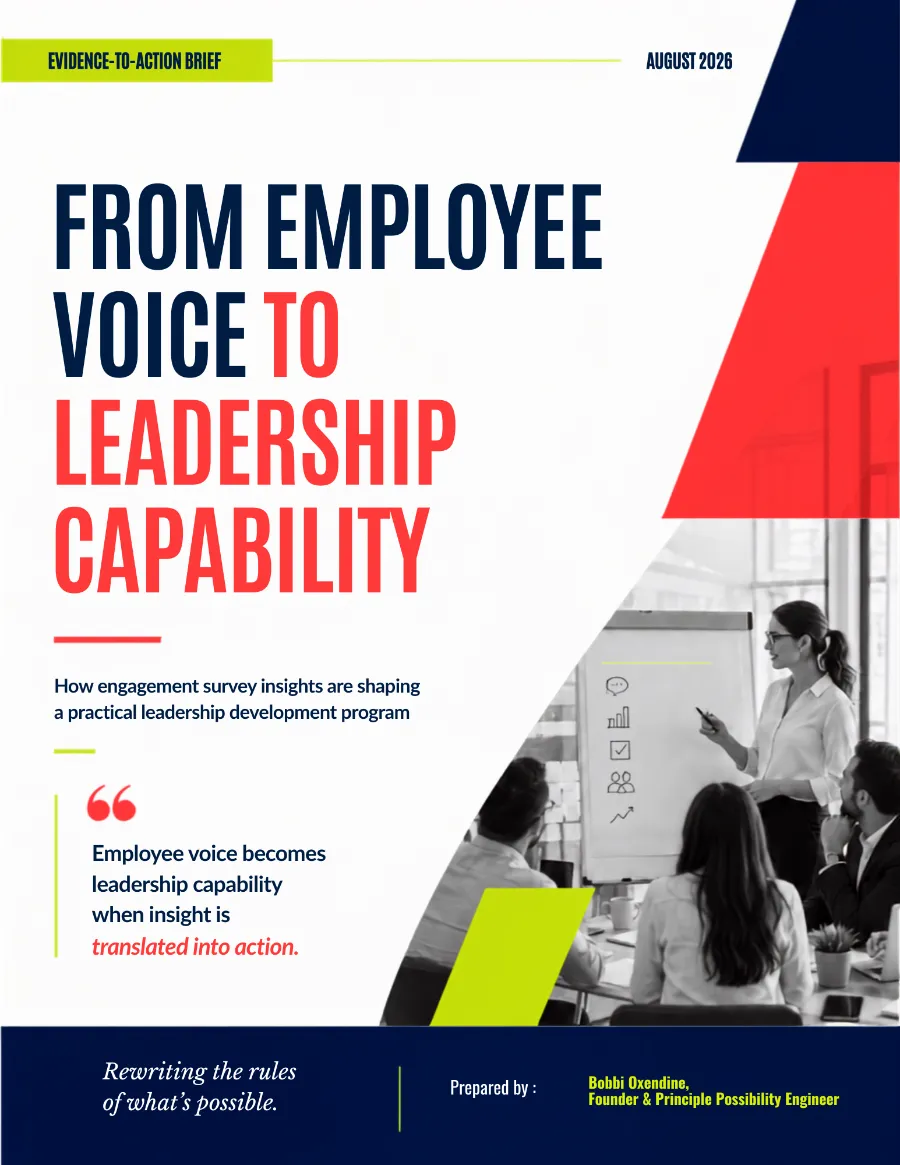 Read the case study
-
01Mapping
132 employee voices informed an assessment across five culture and engagement dimensions, revealing organizational patterns in communication, trust, accountability, recognition, and leadership consistency.
-
02Architecture
The findings informed four leadership action priorities and a practical development program built around shared standards, coaching, communication, and visible follow-through.
-
03Activation
Managers began implementing department-specific action playbooks, turning employee feedback into practical changes in leadership communication, workforce decisions, and day-to-day operations.
Employee insight translated into organizational action.
Survey follow-through also helped identify supervisory capacity challenges, prompting an additional leadership position and a compensation review.
“Possibility Engineering gave us a playbook. They showed us what our employees were saying and the next steps our managers could take to continue what was working and improve what wasn’t.”
Our best partnerships are with leaders willing to look beyond the presenting problem, examine the system honestly, make consequential choices, and stay engaged long enough to build something that works.
- Founders.
- CEOs.
- COOs.
- CHROs.
- Business-unit leaders.
- Transformation leaders.
And senior operators navigating growth, instability, organizational change, or shifts in technology and work.
We specialize in mid-market organizations facing complex change.
- Public sector
- Government agencies and public authorities
- Mission-driven
- Nonprofit, health care and behavioral health, arts and education
- Commercial
- Manufacturing, financial services, technology, retail, transportation, and agriculture
Let’s build what comes next!
It starts with a conversation about what your organization needs to do next, and what may be standing in the way. If there’s a fit, we’ll scope the work and agree what success looks like together. Engagements range from focused advisory work to embedded leadership.